 |
 |
 |
 |
 |
 |
 |
 |
 |

 |
Missile Defense Globally Protects Against Toxic Satellite
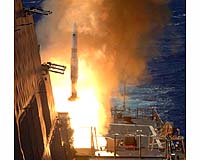
Washington DC (SPX) Feb 19, 2008 Riki Ellison, President of the Missile Defense Advocacy Alliance, (MDAA) www.missiledefenseadvocacy.org went on record in an Alert to the MDAA membership here and globally in an definitive analysis and explanation of the significance of the importance of the missile defense's program capability of the Aegis and the Standard Missile 3 (SM-3) planned use against a NRO falling satellite. His commentary is as follows: "The Vice Chairman of the Joint Chiefs of Staff, General James Cartwright, announced that the Aegis Sea-Based Missile Defense system will be used to intercept a falling U.S. satellite containing toxic rocket fuel in order to reduce the risk of harm to human life as well as to manmade platforms in space, in the air and on earth." "The capability, the adaptability, the investment and the proven technology of our country's missile defense systems has given our nation and our military an option which it never had before to protect human life globally from falling objects from space." "The current threat of a 5,000 pound National Reconnaissance Office (NRO) satellite carrying over 1,000 pounds of Hydrazine gas tumbling down through the atmosphere could be negated by the use of any of the current missile defense systems. All of the deployed missile defense systems, with the exception of Patriot, have successfully intercepted fast moving small objects in space." "Since the United States' decision to deploy missile defense in December of 2002, there have been 16 successful intercepts in space by three different missile defense systems." "The deployed U.S. Aegis ships, equipped with missile defense capability, offer self contained tracking and discrimination and hold numerous Standard Missile-3s in their berths for multiple shots if required to add redundancy and further reduce the risk. This sea-based system has repeated successes destroying very fast warheads around six feet long and between 1,000 and 2,000 pounds in space. The most recent successes were by the Japanese Aegis Ship Kongo on December 17, 2007 and the United States Aegis cruiser Lake Erie (CG 70) on November 6, 2007." "In addition to reducing risk to human life globally, the potential kinetic energy intercept of a tumbling, uncontrolled NRO satellite by the Aegis ship's Standard Missile-3 provides a real use military operational case that, in addition to reducing risk to human life, can enhance the current operational development of the SM-3 and its Aegis System. A typical Aegis Missile Defense test costs the Department of Defense around $40 million." Ellison closed his Alert with the following remarks: "We endorse the flexible use of this remarkable capability and clearly see the return on investment of missile defense for the American taxpayer and Congress. Our country's investment and leadership internationally in Missile Defense provides global options that make our world a safer place. We are a safer world with missile defense than without it." Community Email This Article Comment On This Article Related Links Missile Defense Advocacy Alliance (MDAA) Learn about missile defense at SpaceWar.com Learn about nuclear weapons doctrine and defense at SpaceWar.com All about missiles at SpaceWar.com Learn about the Superpowers of the 21st Century at SpaceWar.com
 MEADS Passes PDR Milestone
 Washington (UPI) Feb 12, 2008
 Lockheed Martin said in a statement that the completion of the PDR marked "a major milestone in the program's development." Northrop Grumman said Thursday it had picked Larry J. Dodgen to be its next sector vice president and deputy general manager for its Mission Systems sector's Missile Defense Division. |
|
|

| The content herein, unless otherwise known to be public domain, are Copyright 1995-2007 - SpaceDaily.AFP and UPI Wire Stories are copyright Agence France-Presse and United Press International. ESA Portal Reports are copyright European Space Agency. All NASA sourced material is public domain. Additional copyrights may apply in whole or part to other bona fide parties. Advertising does not imply endorsement,agreement or approval of any opinions, statements or information provided by SpaceDaily on any Web page published or hosted by SpaceDaily. Privacy Statement |