
 |
 |
 |
 |
 |
 |
 |
 |
 |

 |
Indian Ocean buoys help predict monsoon: scientists
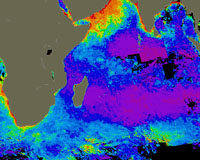
Washington (AFP) May 4, 2009 Scientists said Monday they had reached the halfway point in a project to set up buoys across the Indian Ocean, helping farmers predict the monsoon in some of the world's poorest areas. The buoys measure wind, rainfall, temperature and other figures around the Indian Ocean, which has lagged behind the Pacific and Atlantic Oceans in data collection. The international project, which began in earnest in 2004, has moored 22 buoys so far, with plans to put down all 46 by 2012, said Michael McPhaden of the US National Oceanic and Atmospheric Administration (NOAA). McPhaden, who is based at the NOAA's Pacific Marine Environmental Laboratory in Seattle, said the data would provide a major boost to farmers who rely on monsoon rains. "If you know it's going to be a year of heavy rain or deficient rain, there are different seeds you can plant, different timings and types of fertilizer," he told AFP. "There are all types of strategies you can implement." The project involves Australia, China, France, India, Indonesia, Japan and the United States, along with a coalition of eight African nations. About a third of the world population depends in some way on the Indian Ocean's monsoon rains, which feed agriculture in Asia, Africa and Australia. The monsoons also routinely wreak havoc, last year killing more than 800 people and displacing two million others in India alone. Besides helping the region's farmers better predict monsoons, McPhaden said the United States had an interest as the Indian Ocean affected extreme weather in the Pacific and Atlantic oceans. He said the Indian Ocean project modeled an effort from 1985 to 1994 that lay buoys across the Pacific Ocean, helping scientists monitor the El Nino warming effect and the related La Nina cooling phenomenon. Share This Article With Planet Earth
Related Links Water News - Science, Technology and Politics
 Taps off for two million in water-starved Mexico City
 Mexico City (AFP) April 9, 2009
Some two million residents of Mexico City on Thursday began 36 hours without water under an emergency plan over Easter vacation to respond to a record drop in water supply and to work on repairs. |
|
|

| The content herein, unless otherwise known to be public domain, are Copyright 1995-2007 - SpaceDaily.AFP and UPI Wire Stories are copyright Agence France-Presse and United Press International. ESA Portal Reports are copyright European Space Agency. All NASA sourced material is public domain. Additional copyrights may apply in whole or part to other bona fide parties. Advertising does not imply endorsement,agreement or approval of any opinions, statements or information provided by SpaceDaily on any Web page published or hosted by SpaceDaily. Privacy Statement |
 del.icio.us
 Digg
Digg Reddit
 YahooMyWeb
 Google
 Facebook