
 |
 |
 |
 |
 |
 |
 |
 |
 |

 |
Chandrayaan-1 Launched - Next Stop: The Moon
Paris, France (ESA) Oct 23, 2008 Chandrayaan-1, India's first mission to the Moon, was successfully launched earlier this morning from the Satish Dhawan Space Centre (SHAR) in Sriharikota, India. The PSLV-C11 rocket, an upgraded version of the Indian Space Research Organization's (ISRO' s) Polar Satellite Launch Vehicle, lifted off at 02:52 Central European Summer Time (CEST) and, about 20 minutes later, injected the spacecraft into a highly elongated orbit around the Earth. This marked the beginning of Chandrayaan-1's journey to the Moon, which will culminate with a major manoeuvre - the lunar orbit insertion - in about two weeks. Once the spacecraft is orbiting the Moon, further manoeuvres will progressively lower its altitude to the final 100 km-high circular orbit. At the earliest opportunity, the spacecraft will eject the 'Moon Impact Probe' to provide information about the lunar surface. The mission will then continue from orbit, with remote-sensing studies carried out by its 11 scientific instruments. Three of these instruments were provided by Europe (UK, Germany, Sweden) through ESA.
A new step in India-Europe collaboration Chandrayaan-1, ISRO's first mission beyond Earth orbit, marks the beginning of a new era of collaboration between ESA and India in space science. ESA is making the expertise gained thanks to its SMART-1 lunar mission (2003-2006) available for this collaboration. Apart from coordinating and supporting the provision of the three European instruments (C1XS, SIR-2 and SARA, versions of the first two of which flew on SMART-1), ESA assisted in areas such as flight dynamics and is supporting data archiving and processing. As a result of the collaboration, ESA and ISRO will share the data from their respective instruments. "In an era of renewed interest for the Moon on a world-wide scale, the ESA-ISRO collaboration on Chandrayaan-1 is a new opportunity for Europe to expand its competence in lunar science while tightening the long-standing relationship with India - an ever stronger space power," said Prof. David Southwood, ESA Director of Science and Robotic Exploration. "While the exploration of space calls for new challenges to be overcome, joining forces is becoming more and more a key to future successes." "We congratulate ISRO on the successful launch this morning and we are eagerly looking forward to science to begin," Southwood concluded. Note for editors After the first signature in 1978, the ESA-ISRO cooperative agreement on space has been renewed four times. The latest renewal was signed in January 2007, and covers a period of five years. The specific ESA-ISRO agreement on Chandrayaan-1 was signed in 2005. Chandrayaan-1 is led by ISRO. In addition to ESA, other international partners in the mission include Bulgaria and the USA. The European instruments on board are: - The Chandrayaan-1 Imaging X-Ray Spectrometer (C1XS), developed by the Rutherford Appleton Laboratory (RAL) in the UK in collaboration the ISRO Satellite Centre, Bangalore. It will measure the abundance of magnesium, aluminium, silicon, iron and titanium over the surface of the Moon. - The Smart Near-Infrared Spectrometer (SIR-2), developed by the Max Planck Institute for Solar System Science, Germany. It will explore the mineral resources of the Moon, the formation of its surface features and the different layers of the Moon's crust. - The Sub-kiloelectronvolt Atom Reflecting Analyser (SARA), developed by the Swedish Institute of Space Physics in collaboration with the Space Physics Laboratory of Vikram Sarabhai Space Centre in Thiruvananthapuram, India. It will study the way the Moon's surface interacts with the solar wind, and the surface's magnetic anomalies. Community Email This Article Comment On This Article Share This Article With Planet Earth
Related Links India - Europe cooperation Mars News and Information at MarsDaily.com Lunar Dreams and more
 India launches first moon mission
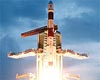 Sriharikota, India (AFP) Oct 22, 2008
India successfully launched its first lunar mission Wednesday, marking a major boost for the country's space programme and a new step in the fast-developing Asian space race. |
|
|

| The content herein, unless otherwise known to be public domain, are Copyright 1995-2007 - SpaceDaily.AFP and UPI Wire Stories are copyright Agence France-Presse and United Press International. ESA Portal Reports are copyright European Space Agency. All NASA sourced material is public domain. Additional copyrights may apply in whole or part to other bona fide parties. Advertising does not imply endorsement,agreement or approval of any opinions, statements or information provided by SpaceDaily on any Web page published or hosted by SpaceDaily. Privacy Statement |
 del.icio.us
 Digg
Digg Reddit
 YahooMyWeb
 Google
 Facebook