
 |
 |
 |
 |
 |
 |
 |
 |
 |

 |
A Bright Future With Solar Lanterns For India's Poor
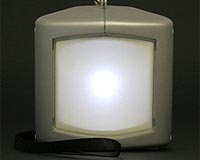
Taiwan (SPX) May 01, 2009 Solar energy has the potential to improve the living conditions of poor rural households in India as well as contribute to the country's future energy security, according to Professor Govindasamy Agoramoorthy from Tajen University, who is Tata-Sadguru Visiting Chair, and Dr. Minna Hsu from the National Sun Yat-sen University in Taiwan. Their study, looking at the benefits of solar lanterns on the livelihoods of village communities in Western India, as well as sustainable use of the environment, has just been published online in Springer's journal Human Ecology. In India, approximately 70 percent of rural areas lack electricity and over 60 percent of rural households use kerosene lamps for lighting. Kerosene lamps are not only expensive, they are also inefficient, potentially dangerous and a major source of greenhouse gases. Interestingly, the average number of sunny days in India ranges from 250 to 300 days a year, with a solar energy equivalent greater than the country's total energy consumption. Energy efficiency is critical to nations such as India with large and growing populations. Solar lanterns, which make the most of the country's natural and abundant sunshine, could be a practical and clean energy alternative to kerosene lamps in village communities. Sadguru Foundation, a non-profit agency specializing in natural resources management in India, supplied 100 solar lanterns to socially and economically disadvantaged households in 25 villages in the Dahod District of the Gujarat State between January 2004 and December 2007. Agoramoorthy and Hsu studied the effects of using solar lanterns on energy usage, household savings in terms of kerosene and electricity costs, as well as the family's quality of life. The women in the households were interviewed a month before and again a month after the introduction of the solar lanterns. Overall, expenditure on kerosene and electricity dropped significantly in all households, after the solar lanterns were introduced. On average each household made important savings ranging from 150 to 250 US dollars annually. Whereas both households above and below the poverty level used a similar amount of electricity before the lanterns were introduced, after their introduction households below the poverty level used significantly less electricity than those above the poverty level. The researchers also found that the solar lanterns particularly benefited school-aged children and women. Although 70 percent of the villages are connected to the power grid, they do not receive power early in the morning or in the evening because the state power company redirects electricity to major towns and cities. However, with the six hours of light supplied daily by the solar lanterns, study hours increased which had a positive influence on the children's performance at school. Women were also able to perform their routine household work both indoors and outdoors during power outages. The authors conclude that "the use of solar energy will contribute to India's future energy security, particularly in rural areas where the technology that converts sunlight directly into electricity offers a decentralized alternative to uncertain electricity supplies. If implemented efficiently, renewable energy projects could not only improve the quality of life for India's rural poor but also enhance sustainable use of the environment." Share This Article With Planet Earth
Related Links Tajen University All About Solar Energy at SolarDaily.com
 First Solar To Supply Modules For Australia's Largest Solar PV Installation
 Tempe AZ (SPX) May 01, 2009
First Solar has announced that it will supply photovoltaic (PV) modules to Solar Shop Australia, Pty Ltd. (Solar Shop), for a 1 megawatt (MW) DC rooftop project. |
|
|

| The content herein, unless otherwise known to be public domain, are Copyright 1995-2007 - SpaceDaily.AFP and UPI Wire Stories are copyright Agence France-Presse and United Press International. ESA Portal Reports are copyright European Space Agency. All NASA sourced material is public domain. Additional copyrights may apply in whole or part to other bona fide parties. Advertising does not imply endorsement,agreement or approval of any opinions, statements or information provided by SpaceDaily on any Web page published or hosted by SpaceDaily. Privacy Statement |
 del.icio.us
 Digg
Digg Reddit
 YahooMyWeb
 Google
 Facebook