 |
 |
 |
 |
 |
 |
 |
 |
 |

 |
World's biggest squid reveals 'beach ball' eyes
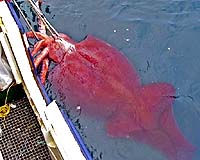
Wellington (AFP) April 30, 2008 The largest squid ever caught began to reveal its secrets Wednesday, including beach ball-sized eyes that scientists said were the biggest known in the animal kingdom. The 495-kilogram (1,090-pound) colossal squid -- accidentally caught by a fishing boat in Antarctic waters in February 2007 -- is slowly thawing under the fascinated gaze of a team of scientists at the Museum of New Zealand. While defrosting took longer than expected Wednesday, one of the earliest revelations were eyes measuring 27 centimetres (11 inches) across with lenses of 10 to 12 centimetres in diameter. In comparison, a human eye measures around one inch, less than a tenth the size. "We saw two of the most sensational eyes possible," Auckland University of Technology marine biologist Steve O'Shea told journalists. Professor Eric Warrant of the University of Lund in Sweden, said the eyes had shrunk after the squid was frozen. The live animal would have had eyes measuring about 40 centimetres across, "about the size of a beach ball." These would help the squid to locate prey in the dark of its habitat 1,000 metres (3,300 feet) or more below the surface of Antarctic waters, he said. Auckland University of Technology scientist Kat Bolstad told reporters the eyes were "the biggest eyes ever recorded in the animal kingdom." The scientists were surprised to find the squid was shorter than they had expected at 4.2 metres when it thawed enough to be laid out. Museum project manager Chris Paulin said the length of mantle, or trunk of the body, was comparable to a specimen found in 2003. But the latest squid is 195 kilograms heavier, he said in a blog on the museum's website following the examination. "The two long tentacles that the fishermen observed have shortened and shrunken considerably post mortem, giving a final total length of 4.2 metres," he said. Those tentacles carry up to 25 rotating hooks each, while eight arms each contain up to 19 fixed hooks used to capture prey and bring it to the squid's beaked mouth. O'Shea and his colleagues believe larger squid still lurk in the southern ocean depths. The squid's lower beak measures around 40 centimetres across, while other beaks have been found -- usually in the stomach of predator sperm whales -- measuring up to 49 centimetres. O'Shea said it is possible that colossal squid (Mesonychoteuthis hamiltoni) may grow to up to 750 kilograms but there was not yet enough information to be sure. "When I said in 2003 that colossal squid could grow to 500 kilograms no one believed me, I was ridiculed, people laughed at me," he said. The scientists are now trying to probe the squid to find out what its last meal was, according to the website. The progress of the examination is being shown by webcams on the museum's website www.tepapa.govt.nz Community Email This Article Comment On This Article Related Links Darwin Today At TerraDaily.com
 Mexican sunflower origin is determined
 Tallahassee, Fla., April 29, 2008
 U.S. and Mexican scientists have determined ancient farmers were growing sunflowers in Mexico more than 4,000 years before the Spaniards arrived. |
|
|

| The content herein, unless otherwise known to be public domain, are Copyright 1995-2007 - SpaceDaily.AFP and UPI Wire Stories are copyright Agence France-Presse and United Press International. ESA Portal Reports are copyright European Space Agency. All NASA sourced material is public domain. Additional copyrights may apply in whole or part to other bona fide parties. Advertising does not imply endorsement,agreement or approval of any opinions, statements or information provided by SpaceDaily on any Web page published or hosted by SpaceDaily. Privacy Statement |